Exploring the Connection Between Order of the Sinking Star and The Witness
Learn about the development ties between Order of the Sinking Star and The Witness, including their shared design philosophy and unique puzzle mechanics.
Published: Order of the Sinking Star Wiki Editorial Team
Table of Contents
Understanding the Relationship Between the Titles
Many players seeking a connection between Order of the Sinking Star and The Witness are identifying the shared creative vision of director Jonathan Blow. While both titles are products of Thekla, Inc., they occupy different conceptual spaces in the puzzle genre. The Witness is widely recognized for its cohesive, island-based exploration and singular line-drawing mechanics. In contrast, Order of the Sinking Star functions as an expansive, multi-layered "game design supercollider."
Rather than building from one core concept, Order of the Sinking Star synthesizes mechanics from four specific foundational games: Heroes of Sokoban (Jonah Ostroff), Skipping Stones to Lonely Homes and Mirror Isles (Alan Hazelden), and the Promesst series (Sean Barrett). While fans of The Witness will recognize the focus on high-quality puzzle progression and environmental storytelling, Order of the Sinking Star offers a vastly different, class-based mechanical experience that integrates shifting characters and abstract puzzle logic.
Design Philosophy and Puzzle Complexity
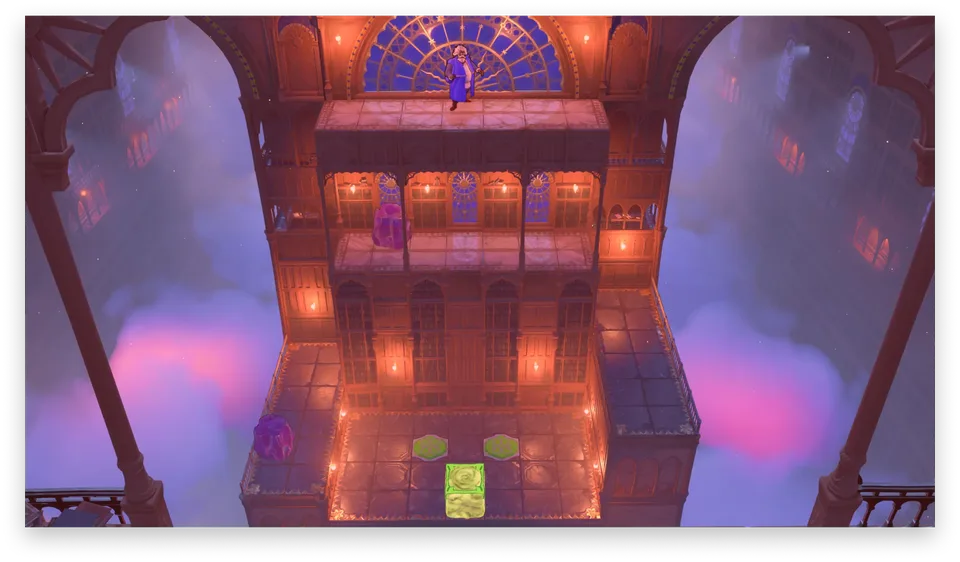
A major point of comparison is the evolution of puzzle abstraction. In The Witness, players learn a mechanic and apply it to an environment to uncover truths. In Order of the Sinking Star, the challenge stems from how different gameplay systems collide. As you move through the four distinct worlds, you are tasked with managing heroes—such as rogues, wizards, and soldiers—each with unique interactions like pushing, teleporting, or swapping places with reflections.
Jonathan Blow has noted that both games share a philosophy regarding "abstraction levels." You begin by mastering the basic grid-based movement of each world, but as you progress, these rules intertwine in ways that demand lateral thinking. Players can expect a significantly higher volume of content, with over 1,000 handcrafted puzzles compared to the more contained nature of The Witness. This density allows for a non-linear approach where you can switch between worlds if you hit a mental block, a feature designed to mitigate the frustration often associated with difficult puzzle games.
Development Context and Legacy
Order of the Sinking Star has been in development for nearly a decade, largely serving as a successor to the lessons learned during the creation of The Witness. A significant change in the studio's workflow involves the engine and programming language. While The Witness was written in C++, Thekla, Inc. developed an entirely new, in-house programming language—named "Jai"—specifically to streamline the creation process for this new title.
This shift indicates the studio's intent to push past the traditional limits of puzzle design. The project incorporates design contributions from several prominent indie developers, including Patrick Traynor (Patrick's Parabox) and Marc ten Bosch (Miegakure). This collaborative "supercollider" approach reflects a move toward a more massive, interconnected puzzle ecosystem that distinguishes it from the more isolated, meditative experience of The Witness.
FAQ: What You Should Know
Do I need to have played The Witness to understand Order of the Sinking Star?
No, the two games are completely standalone. While they share a director and a high bar for puzzle quality, they do not share a story or gameplay continuity.
Is there a demo available for Order of the Sinking Star?
The game was featured in a Steam Next Fest demo in June 2026. Please check the official Steam store page for the most current availability regarding trials or updates.
How does the difficulty compare to Jonathan Blow's previous work?
According to player reports and critics, the game maintains a steep difficulty curve that rewards persistent, logical thinking. It lacks difficulty sliders and hints, mirroring the uncompromising design style found in his previous projects, though it provides more flexibility in puzzle order to help manage fatigue.