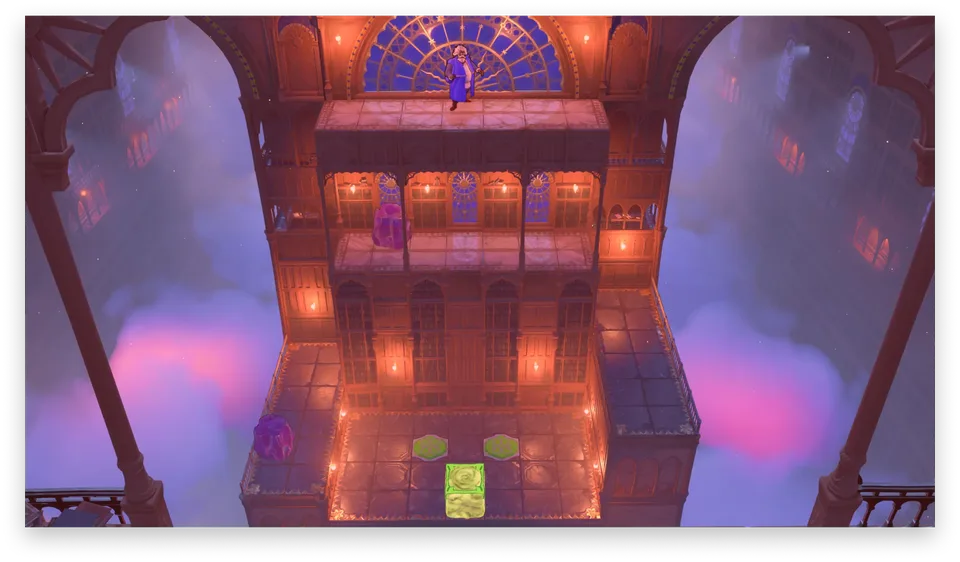
Order of the Sinking Star: Gameplay Mechanics and Puzzle Guide
Master the puzzle mechanics in Order of the Sinking Star, including character abilities, world interactions, and complex challenges from the game's anthology-style design.
Published: Order of the Sinking Star Wiki Editorial Team
Table of Contents
Understanding the Anthology Structure
Order of the Sinking Star, developed by Thekla, Inc., is not a traditional linear puzzle game. Instead, it functions as an expansive anthology of sub-games, each with its own thematic setting and unique set of mechanics. According to official reveals, players start by exploring these individual worlds—such as The Heroes of Hauling, The Mirror Isles, The Promise, and Skipping Stones to Lonely Homes—before the game shifts focus.
The core challenge arises when these worlds collide. The game’s brilliance lies in its combinatorics; objects and characters from one world begin to interact with the laws and puzzles of another. For instance, a wizard’s teleportation ability might be used in conjunction with mirror mechanics, or light beams may be directed at monsters from a completely different sub-game.
Mastering Character Abilities
Each character in the game serves as a "key" to specific puzzle types. Based on community reports, the game utilizes a wide array of keyboard inputs to swap between heroes, each bringing a specific utility to the table:
The Heroes (North): A band of fantasy characters including a warrior, thief, wizard, bard, cleric, and druid. Each hero offers different puzzle powers, such as manipulating plants or moving objects.
The Mirror Isles (East): Focuses on a wealthy trader who uses mirrors to swap positions with reflections. This mechanic is essential for navigating archipelagos and solving spatial puzzles.
The Promise (West): An exploration-heavy section where an explorer uses giant gems to power beams of light. These beams allow for walking through walls, smashing boulders, and performing up to 12 distinct abilities.
Skipping Stones (South): Involves a marooned sailor navigating a world of redirectable rivers, rideable lily pads, and skipping stones.
Tip
Cross-World Interaction: When you reach the stage where worlds collide, don't assume a character's utility is limited to their home area. Experiment with combining abilities—such as using the wizard’s teleportation with mirror-based movement—to uncover solutions that seem impossible at first glance.
Solving Complex Puzzles
Community discussions highlight that the game’s puzzles are designed to be rewarding rather than frustrating. Players often find that the most complex challenges require a shift in perspective. If you are stuck on a "boss puzzle" or a multi-world interaction, consider the following strategies:
Analyze the Environment: Puzzles often involve hidden tiles or specific interaction orders. If an assumption (like "drowning monsters one by one") fails, look for ways to make a monster appear between two others or reposition a mirror to create new paths.
Don't Overcomplicate: Players frequently report that they over-analyze initial setups. Sometimes, the solution involves a simpler interaction than the one you are currently attempting.
Utilize the Overworld: The overworld is not just a hub; it contains its own puzzles and secrets. The way you travel between sub-games can often provide the necessary context or tools to solve puzzles within the sub-games themselves.
Frequently Asked Questions
Are the sub-games independent?
Initially, yes. You can play through The Heroes of Hauling, The Mirror Isles, The Promise, and Skipping Stones in any order. However, the game is designed to eventually weave these worlds together, creating a unified, complex universe where mechanics overlap.
How many puzzles are in the game?
According to the developers, the game contains over 1,000 puzzles. While the demo version provided a smaller selection (approximately 97 puzzles in some builds), the full experience is significantly larger.
Where can I find more information?
For official updates, visit the Order of the Sinking Star Steam Page. Community forums are also excellent resources for discussing specific puzzle logic and sharing "aha!" moments with other players.