Order of the Sinking Star: Everything We Know About Jonathan Blow’s New Puzzle Game
Explore the mechanics, development background, and unique world-building of Order of the Sinking Star, the ambitious new title from Thekla, Inc.
Published: Order of the Sinking Star Wiki Editorial Team
Table of Contents
Understanding the Development of Order of the Sinking Star
Order of the Sinking Star represents a decade of development by Thekla, Inc. Following the 2016 release of The Witness, Jonathan Blow shifted his focus toward creating a custom programming language, now widely known as "Jai." What began as a technical proof-of-concept for this language evolved into what Blow describes as the most ambitious project of his career.
The game is built on a "super collider of game design" philosophy. Rather than creating a single, linear puzzle experience, the development team designed four distinct biomes, each operating as a self-contained game with its own unique mechanics, characters, and narrative. By mashing these disparate design elements together, the game aims to create a complex, interconnected space that avoids the common plateau of difficulty found in traditional puzzle games.
Gameplay Mechanics and World Exploration
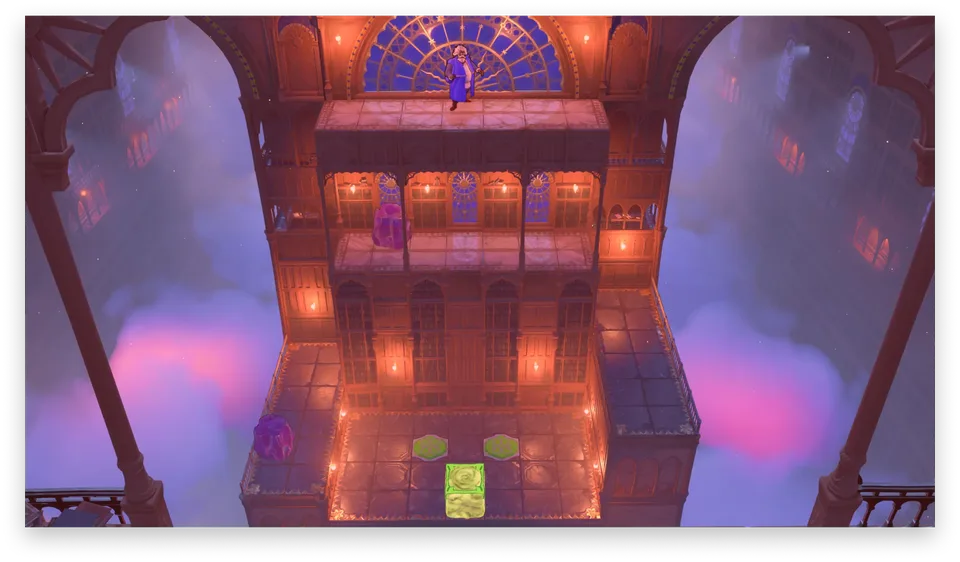
The game is a top-down, grid-based puzzle adventure set in a colorful open world. Players take on the role of a Queen transported to a mysterious realm. Exploration is non-linear; while the map starts largely shrouded in fog, players can travel in cardinal directions to reveal new territories.
Character-Specific Talents: Each biome introduces a character with a specific ability. For instance, the Thief automatically drags adjacent objects when moving backward, while the Wizard swaps places with movable objects.
Mechanical Progression: Solving initial puzzles in a territory unlocks that area's mechanic for the Queen to use in the overworld, facilitating further exploration.
Collaborative Puzzles: A primary hook of the game is the convergence of these worlds. As different landmasses border one another, characters from different regions can interact, requiring players to combine their unique talents to solve complex puzzles that neither could finish alone.
Puzzle Structure and Game Depth
With thousands of puzzles included, Order of the Sinking Star is designed to be massive. According to developer insights, approximately 20 to 30 percent of early-game puzzles are optional, though the ratio of optional content increases as the game progresses.
Tip
Non-Linear Progression: Similar to The Witness, the game encourages players to explore elsewhere if they hit a wall. The non-linear structure allows you to tackle different biomes at your own pace, ensuring that you aren't forced to solve a single mandatory path to continue.
The game also features "gold rooms" containing special puzzles that, once completed, help activate teleporters across the map. Activating at least four of these six teleporters allows players to reach the endgame. The narrative is similarly non-linear, leading to one of three possible conclusions depending on the player's journey.
Community Observations and Performance
As the game has moved into the hands of early players, discussions have emerged regarding its technical performance and design philosophy.
Performance: Some community members have reported high GPU utilization despite the game's stylized, top-down art direction. While some users report "butter smooth" performance, others have suggested that optimization remains a point of interest during the development cycle (Source: Quarter To Three Forums).
Accessibility and Pacing: Players familiar with previous titles like Braid and The Witness have noted that the sheer volume of puzzles and the grid-based nature of the game require a different mindset. Community reports suggest that the game's depth is its greatest strength, though it demands significant commitment to navigate the interplay of mechanics effectively.
Frequently Asked Questions
Is there a demo available?
As of the latest updates, players have noted the existence of trial content, but it is important to distinguish between specific demo offerings and the full scope of the game. Always verify the current Steam store page for the most accurate information regarding availability.
Can I play the game on consoles?
While the game is confirmed for PC, a console release has not been officially ruled out by the developers.
How difficult is the game?
The difficulty scales as players progress. Because the game is designed to be non-linear, you have the freedom to skip a significant portion of puzzles if you find yourself stuck, allowing you to return to them after gaining more experience with the world's mechanics.